
Stepping into Chinese culture, whether for business or pleasure, is an exciting adventure. It’s a journey into a world of breathtaking history, incredible cuisine, and dynamic modernity. But beyond the language barrier and the iconic landmarks lies a more subtle, yet equally important, challenge: understanding the unspoken rules of social conduct. For Westerners raised on ideals of directness and individualism, the nuanced, relationship-focused etiquette of China can seem like a complex and inscrutable code.
Navigating this landscape isn’t about memorizing a rigid list of rules out of fear. Instead, it’s about embracing a new social grammar—a way of communicating respect, building trust, and showing that you value the relationship above the transaction. A small gesture, like how you present a business card or where you sit at a dinner table, speaks volumes about your cultural sensitivity and your intentions. This guide is designed to demystify that process. We’ll explore the core principles that shape Chinese social behavior and provide you with practical, actionable tips to help you build bridges, avoid awkward blunders, and create meaningful connections that last.
The Foundation: “Mianzi,” Harmony, and Hierarchy
Understanding Chinese etiquette means looking beyond the rules to the principles that shape them. Before diving into specific situations, grasping the “why” behind Chinese etiquette is crucial. The behavior you’ll see is deeply rooted in three key ideas:
- Mianzi (Face): Think of the concept of “face” as a person’s social reputation, dignity, and honor. It’s a collective responsibility to help others maintain their face and avoid causing them embarrassment. Causing someone to lose face through public criticism, blunt refusals, or embarrassment can make someone “lose face” and is a serious misstep. Conversely, giving someone face by praising them appropriately or deferring to their opinion strengthens your relationship!
- Collectivism: The focus is on “we” rather than “I.” Branching from the concept of ‘Mianzi’ and in pursuit of social harmony, maintaining group cohesion is prioritized over individual expression. Decisions and actions often consider the family, company, or group’s needs first. This is the opposite of the Western celebration of individualism and explains why consensus and relationship-building are so vital.
- Confucian Values: This is underpinned by Confucian values, an ancient philosophy emphasizing respect for elders, authority, and the importance of the group over the individual. This structure is accepted as the natural order for a stable society. Age and position command automatic respect, and smooth, harmonious relationships are the ultimate goal.
With this foundation in mind, let’s explore how these principles play out in everyday interactions.
1. Greetings & Introductions: Setting the Right Tone
First impressions matter everywhere, but in China, they set the stage for the entire relationship. The initial meeting is where you demonstrate your understanding of hierarchy and respect. Formality is not coldness; it is a sign of respect and seriousness.
Your goal is to show deference and formality, which builds trust and shows you are serious about the relationship.
Top Tips for Greetings:
- Honor the Hierarchy: Always greet the eldest or most senior-ranking person first. For example, in group introductions, state the name of the host, younger person, or lower-ranking person first, as in “Mr. Li, I’d like to introduce our Director, Ms. Chen.”
- The Handshake: A light, not overly firm, handshake is standard. Wait for your Chinese counterpart to initiate.
- Mind Your Titles: Use formal titles like “Mr.” (先生, Xiānshēng), “Ms.” (女士, Nǚshì), or a professional title (e.g., “Director Wang”) followed by their surname. Never use first names until you are explicitly invited to do so.
- The Business Card Ritual: Treat a business card as an extension of the person; treat it with the same respect you would show the person.
- Present and receive with both hands, with the text facing the recipient.
- Study it carefully for a moment—don’t just pocket it immediately.
- Place it respectfully in a card holder or on the table in front of you during a meeting.
- Avoid Sensitive Topics: Steer conversations toward neutral or positive ground to maintain a harmonious atmosphere. Politics, Taiwan, Tibet, and personal finances are considered highly sensitive and are best avoided, especially during social meals!
2. Dining Etiquette: A Feast for Relationship Building
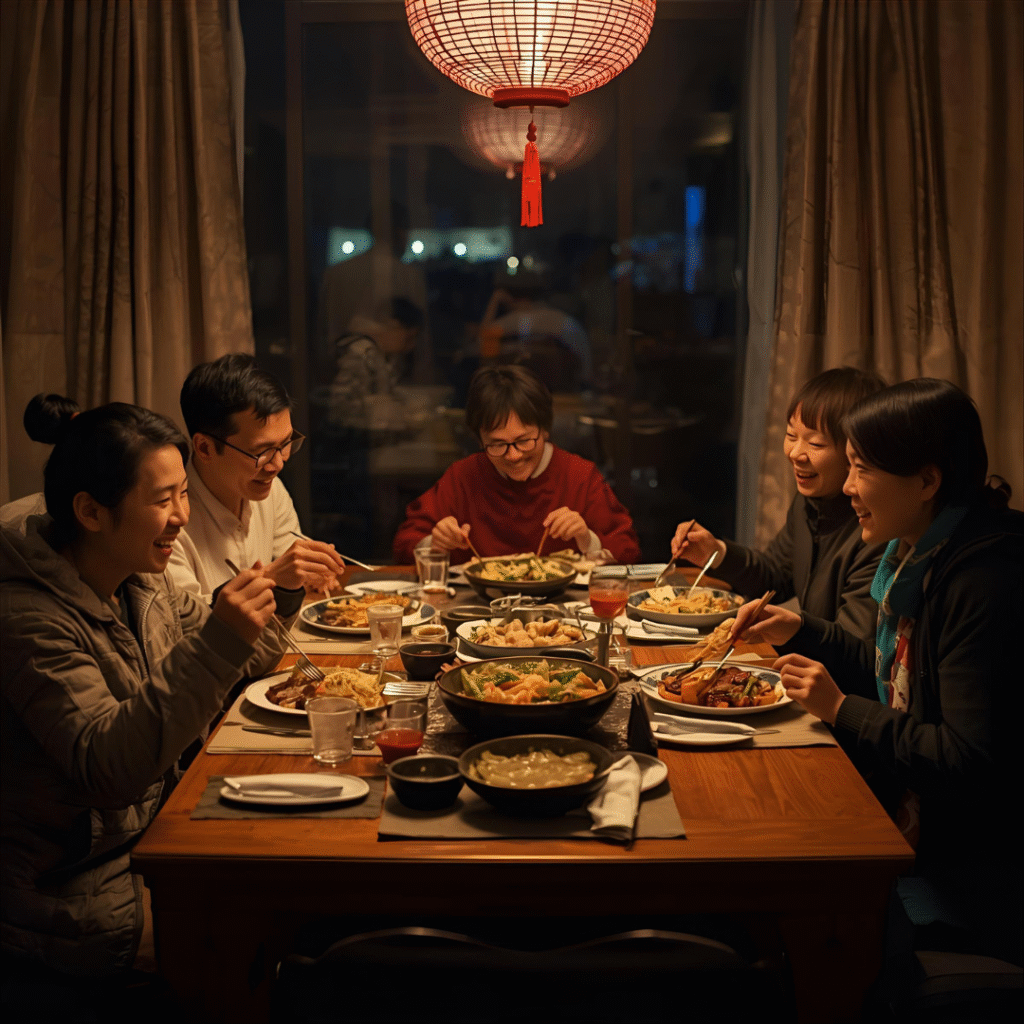
Dining is a central part of Chinese social and business life. It’s less about the food and more about building “Guanxi” (relationships). The table is a microcosm of Chinese society, where hierarchy and harmony are on full display. However, the complex rules are not meant to intimidate, but to create a harmonious and respectful atmosphere for all.
Top Tips for Dining:
- Seating is Symbolic: The guest of honor is usually seated directly opposite the host, and the seat of honor faces the door. The host will typically guide you to your seat—never sit down randomly!
- The Honor of Starting: The meal begins only after the host or guest of honor has taken the first bite. If the setting is more casual, the eldest or most senior person should begin eating first. Similarly, don’t be the first to grab food from a new dish.
- Chopstick Commandments:
- Never stick your chopsticks upright in a bowl of rice. This resembles incense offered to the deceased and is extremely offensive.
- Don’t tap your bowl with them, point with them, or wander around the table with them in hand.
- Use the blunt end or public serving spoons/chopsticks to take food from shared plates, don’t use your own!
- Don’t spear food with your chopsticks or gesture with them.
- Be a Toasting Pro: The host will offer the first toast. It is polite to reciprocate later in the meal. When toasting, your glass should be slightly lower than that of your elders or superiors as a sign of respect. Also, if you really want to impress, keep an eye on your neighbors’ tea cups; refilling them is a polite gesture!
- The Last Piece: It’s polite to offer the last piece of food on a shared plate to someone else.
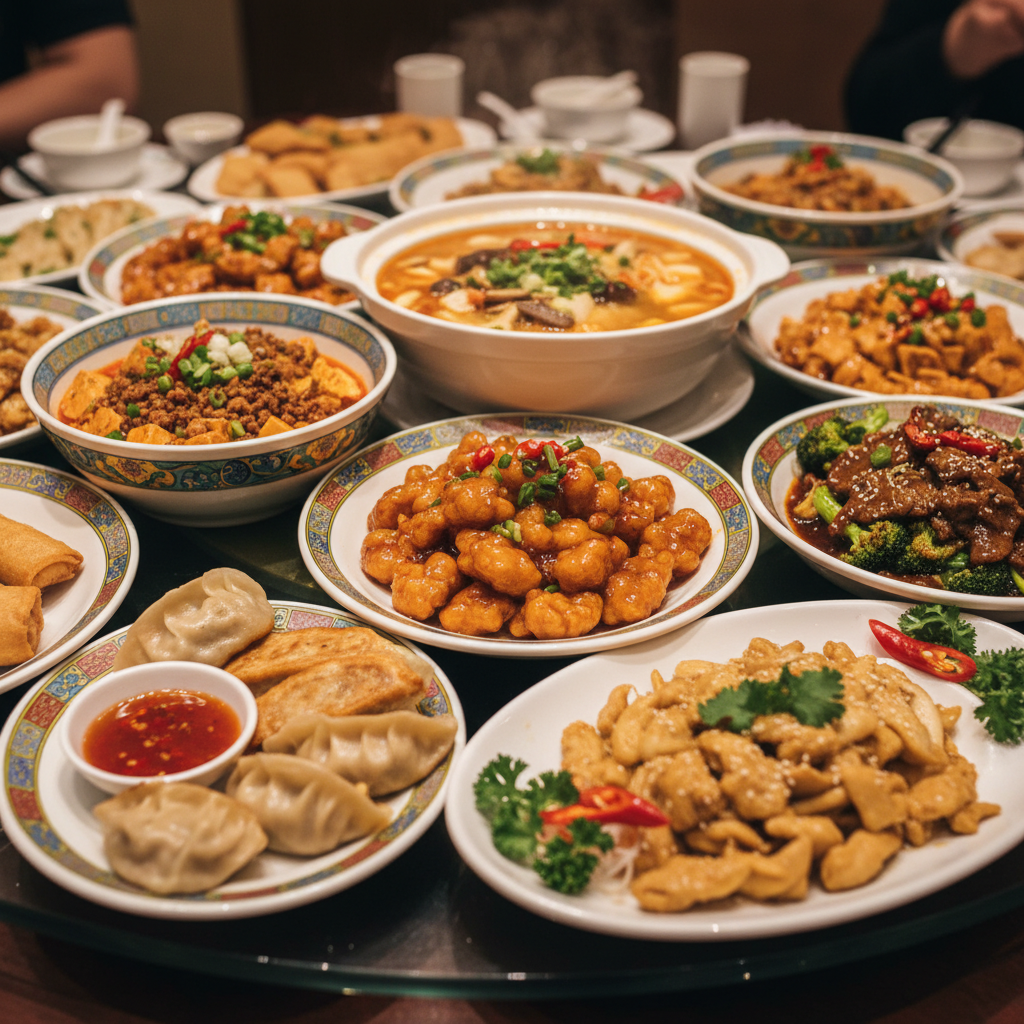
In China, food is more than sustenance—it’s a language of care, community, and respect. Understanding dining etiquette allows you to fully participate in this beautiful tradition. One of the best ways to immerse yourself is through a dim sum meal. To prepare for this experience, check out our guide on what dim sum to order to navigate the menu like a local.
3. Gift-Giving: The Art of Thoughtful Gestures
Gift-giving is a nuanced art form in China, symbolizing respect, goodwill, and the desire for a continued relationship. The thought and symbolism behind the gift are often more important than its monetary value.
Top Tips for Gift-Giving:
- The Presentation: Always give (and receive) a gift with both hands. This also applies to gifts, cards, and even documents.
- Wrapping & Colors: Red and gold are excellent as they are lucky colours. Avoid white, blue, or black paper, as they are associated with funerals.
- The Receiving Ceremony: Politely refuse once or twice (“Oh, you shouldn’t have!”) before accepting with both hands. It is customary not to open the gift immediately to avoid any potential embarrassment if the gift is modest or to avoid appearing greedy (unless the giver insists you open it of course).
- Gifts to Avoid: Steer clear of clocks (symbolizing running out of time), sharp objects like knives or scissors (signifying cutting ties), handkerchiefs (associated with weeping)!
4. Business & General Behavior: Building Trust
Business in China is conducted between people, not just companies. Trust, or “Guanxi,” is the bedrock of every deal, and etiquette is the tool used to build it. Patience and the ability to read indirect signals are critical assets.

Top Tips for Business & Behavior:
- Protect “Face” at All Costs: Never publicly criticize, embarrass, or directly contradict someone. Use phrases like “We will consider it” or “This requires further study” as polite refusals. If you have an issue, address it privately and subtly.
- Punctuality is Respect: Being on time is a basic expectation. For meetings, aim to be 5-10 minutes early as this shows you are serious and respectful of their time.
- Communication Style: Communication is indirect and subtle. “Yes” may mean “I hear you,” not agreement. A direct “no” is considered rude. People may say “maybe,” “we’ll study it,” or “it’s somewhat difficult” to convey a negative answer. Read between the lines, pay close attention to body language, tone, and what is not being said. Confrontation is avoided to preserve harmony.
- Mind Your Body Language: Avoid excessive physical contact, back-slapping, or loud, boisterous behavior. Maintain a calm and composed demeanor.
- Seniority is Key: The presence of senior executives on your team signals the importance you place on the partnership. The highest-ranking person on your team should lead the discussions; defer to them in meetings and follow the hierarchical seating.
Final Thoughts: Etiquette as Your Gateway to Deeper Connection
Mastering Chinese etiquette is a continuous learning process, not a one-time test. There will be moments of uncertainty, and that’s perfectly okay. What truly matters is the genuine effort you make. Your Chinese hosts, colleagues, and friends will deeply appreciate any attempt to engage with their culture on its own terms, and they are often very forgiving of well-intentioned missteps.
Remember, the goal of all these customs—from the careful exchange of business cards to the shared rituals of a meal—is to foster harmony and build “Guanxi,” the powerful network of relationships that forms the backbone of Chinese society. By prioritizing the group, showing respect for hierarchy, and protecting the “face” of others, you do more than just follow rules; you demonstrate the empathy and sincerity that are the first step toward building successful and lasting relationships. Approach your interactions with this open and prepared mindset, and you will find yourself moving beyond the role of a tourist into the rewarding space of a trusted and respected friend.
You are now equipped with the essential knowledge to navigate China with cultural confidence! But the journey doesn’t have to end here. To move from respectful observer to genuine connector, the next step is to unlock the power of language learning and rewire your mind and pick up some language skills to connect with locals even better on your adventures!
祝你好运 (Zhù nǐ hǎo yùn) — may you have good fortune on your journey!
*Here’s a little transparency: Our website contains affiliate links. This means if you click and make a purchase, we may receive a small commission. Don’t worry, there’s no extra cost to you. It’s a simple way you can support our mission to bring you quality content.*
This guide is a cultural compass — thoughtful, practical, and deeply respectful.
You don’t just teach etiquette; you invite us to feel it, to understand the values beneath the gestures, and to build bridges with sincerity.
Six excerpts, one coherent philosophy:
• Foundations: Mianzi, harmony, and hierarchy as relational pillars
• Greetings: Titles, gestures, and timing as signals of respect
• Dining: Guanxi at the table — etiquette as emotional choreography
• Gift-giving: Symbolism over price — generosity as cultural fluency
• Business behavior: Trust built through subtlety, seniority, and presence
• Final thoughts: Empathy over perfection — effort as the true connector
At LANICHEDUCLIP, we often say: “Etiquette is not about rules — it’s about rhythm.”
This guide could easily become a bilingual capsule series, a visual onboarding tool, or a cross-cultural resource for entrepreneurs, educators, and travelers.
What makes this work exceptional is its tone: warm, non-judgmental, and empowering.
You honor the complexity of Chinese culture while making it accessible to those who seek to engage with humility.
Thank you for crafting a guide that teaches more than behavior — it teaches mindset.
From handshake to hierarchy, you’ve shown that every gesture is a chance to connect.
Hi there, thank you! What a profoundly thoughtful and generous reading of this guide. I think you articulated its purpose better than I ever could!
I’m truly moved that you connected with the emphasis on mindset over mere rules. The idea of “etiquette as rhythm” from is beautiful and perfectly captures the fluid, sincere engagement I hoped to encourage. I’m so happy that you distilled the core philosophy so coherently 🙂 It’s so meaningful to me to create content that resonates with educators and travelers who, like you, approach cross-cultural connection with such depth and respect.
Your comment has made my day. Thank you for taking the time to share these insights!
Great article, I really like how have explained not just what to do, but why these customs matter in Chinese culture.
The part about dining etiquette and the symbolism behind gestures like seating and toasting was especially eye-opening—it’s amazing how much meaning is conveyed through such thoughtful traditions.
What do you think are the most common etiquette mistake Westerners make when first doing business or socializing in China? I am trying to plan a trip to China I’m glad I found this article.
Thank you! I’m so glad you enjoyed the article and found the dining etiquette section insightful. It really is a beautiful and symbolic process.
To your great question, I’d say the most common mistake is underestimating the importance of the hierarchy and formality at the beginning of a business relationship. I think diving straight into business without first building rapport through small talk, or failing to properly acknowledge the most senior person in the room, can start things off on the wrong foot. The relationship (guanxi) always comes before the transaction.
So excited for your upcoming trip! Wishing you a wonderful journey 🙂
The Chinese have some wonderful values in their system. For instance respecting your elders is something more of us should think about doing. I am glad you warned me to greet the oldest first, as I would not have know this.
I also like their business card etiquette, as most people you give a business card to simply pocket it without even glancing at it. I like that they expect you to at least read it and then place it in front of you on the table or in a card holder.
Your gift giving guide was also helpful. Does clocks include watches, or can you give a watch as a gift?
Hi Michel, thank you so much for your thoughtful comment! I’m really glad to hear you found the guide helpful and that you’re appreciating the values behind the etiquette, like respect for elders.
That’s an excellent and very specific question about gift-giving! You are right to be cautious. While a watch is functionally different from a large clock, the cultural symbolism are unfortunately very similar. Therefore, it’s generally best to avoid giving a watch as a gift in a traditional Chinese context, as it can still carry the same unfortunate association with “counting one’s final moments.”
This is a perfect example of how the thought behind a gift is what truly counts, and choosing a different item shows wonderful cultural sensitivity. Gifts like fine tea, a nice pen, or high-quality food items are always safe and appreciated alternatives.
I’m so happy this guide was useful for you. Thanks again for asking such a great question!
This is a very informative website about Asian culture. It’s perfect for a traveller who is interested in learning more about Chinese culture. I love the explanation about the meaning of some Chinese language characters, like in this example: 祝你好运 (Zhù nǐ hǎo yùn) — may you have good fortune on your journey.
I found the sections on “Tips for Business & Behaviour”, Tips for Dining”, “Tips for Greeting”, and “Tips for Gift-Giving” particularly very informative and educational. It inspired a desire in me to visit this part of the world. The pictures of people and food are very colourful. I can tell you were very careful in selecting them.
Thank you so much for your thoughtful comment! I’m so happy to hear that the guide was not only informative but also inspiring! It’s wonderful to know that you liked the etiquette sections and the meaning behind 祝你好运 (that’s the kind of cultural connection I hope to foster)! I’m also glad you appreciated the photos! I tried to select images that capture the colour and spirit of the culture 😆.
Wishing you the best of luck on your future travels, I hope you get to experience the wonders of Asia for yourself very soon!
This guide is absolutely outstanding — one of the most comprehensive and insightful explanations of Chinese etiquette I’ve ever read! You’ve done a brilliant job of not just listing “dos and don’ts,” but truly unpacking the why behind each custom. The sections on Mianzi and Guanxi were especially valuable — they really help Western readers understand how deeply respect, harmony, and relationships shape daily interactions in China.
I also appreciated the practical tips for greetings, dining, and business — the kind of real-world guidance that helps travelers and professionals avoid awkward moments while showing genuine cultural awareness. The details about toasting etiquette and business card exchanges were spot-on!
What makes this post stand out is its tone — informative yet approachable, encouraging readers to engage with empathy rather than fear of mistakes. This is a must-read for anyone planning to visit or work in China.
Excellent work, Cian!
Thank you so, so much for this thoughtful and detailed feedback. Reading your comment truly made my day. I’m especially grateful that you highlighted the sections on Mianzi and Guanxi, because I think understanding those core concepts is indeed the key to moving beyond simple rules and genuinely connecting with the culture.
Hearing that you consider it a “must-read” is the highest compliment I could receive. I sincerely appreciate you taking the time to share your kind words!
Great article, very informative Cian! As I am planning on moving to East Asia, I was wondering how different these rules are compared to neighbouring East Asian countries, such as Korea or Japan. Thank you again for such an informative article about Chinese etiquette!
That’s a fantastic question Jennifer! While China, Japan, and Korea share a Confucian foundation of respect and hierarchy, the expression differs. Japan and Korea often emphasize even greater formality and indirect communication. For example, the business card exchange is more ritualized, and while gift-giving is important, the specific taboos (like China’s strong aversion to clocks) are less pronounced.
The core principle of observing, being respectful, and following the lead of your local hosts applies everywhere! Wishing you the best with your move!
Hello, Cian. Thank you for such useful insight in chinese culture. I just moved to Beijing few weeks ago and I really don’t want to seem like a rude tourist with no respect for their culture. That being said, i am still only starting to pick up the language so I was wondering would it be considered rude to answer in english when you are being talked to in Chinese? Should i talk in broken mandarin or just resort to speaking in english.
Hi Lucy, that’s a very common and understandable concern! It’s absolutely not rude to speak English when needed, clear communication is always appreciated. However, making even a small effort in Mandarin first makes a big difference. I’d suggest starting with a simple polite phrase like “对不起,我听不懂” (Duìbuqǐ, wǒ tīng bù dǒng) – “Sorry, I don’t understand,” before switching to English. This immediate show of respect for the local language is always noticed positively and will likely make people more patient and willing to help. Your awareness alone puts you ahead! Wishing you the best in Beijing!
I found the practical examples about greetings, gift-giving, and chopstick etiquette really useful—turns the idea of “etiquette” into actionable steps. Your note on avoiding taboo items like clocks and understanding the importance of showing respect before diving into business hits the mark. For a traveler heading into less-touristed areas of China, do you have guidance on how etiquette may shift more dramatically outside big cities and how to adapt when signage, culture or language are much less Westernised?
Thank you so much for your kind words and for asking such a thoughtful question Clayton! When traveling beyond major Chinese cities, you’ll find the core principles of respect remain the same, but the practice of etiquette often feels more traditional and pronounced. Greetings may become more formal, with simple nods replacing handshakes, and you might encounter more direct curiosity from locals, this is generally a warm gesture of interest.
Since English signage and speakers will be scarce, having a reliable offline translation app and learning a few basic phrases will go a very long way. In these regions, being a patient and observant guest is key; watch how locals interact and don’t hesitate to follow their lead. Your sincere effort to adapt will always be valued more than perfect execution. Wishing you a wonderful and insightful journey!
This is quite an insightful read. Having travelled through Asia quite extensively myself, I’ve always been respectfully conscious of the different cultural and traditional nuances in each country. This is a great window into Chinese etiquette with some really useful tips.
Thank you for your thoughtful comment Leanne! I’m so glad you found the guide insightful, especially given your extensive travel experience in Asia. I think the respectful consciousness of cultural nuances you mention is exactly the right mindset for any traveler, and I truly appreciate you sharing that. Happy and confident travels!
This was such an insightful and culturally rich read! I really liked how you explained not just what to do in Chinese social settings, but why these customs matter. It made the topic feel much deeper and more meaningful. Your breakdown of “Mianzi,” hierarchy, and harmony gave great context for understanding behavior beyond surface-level etiquette. I especially found the dining and business tips fascinating since they show how relationships and respect are intertwined in every interaction. Out of curiosity, which aspect of Chinese etiquette do you think Western visitors struggle with the most when they first arrive?
Hi Kavitha, thank you for such a kind and insightful comment! I’m thrilled you enjoyed the read and appreciated the deeper dive into the “why” behind the customs. You’ve asked a great question. I think Western visitors often struggle the most with the indirect communication style required to preserve “Mianzi” (face). Being overly direct or confrontational, especially in public or business settings, can be jarring in a culture that highly values harmony. It’s a shift from “say what you mean” to “mean more than you say.” It’s exactly as you noted, it shows how respect is woven into every single interaction!
Chinese etiquette is deeply rooted in the values of harmony, hierarchy, and saving “face,” which shape how people communicate, dine, and build relationships. For Westerners, the indirect communication style, emphasis on group over individual, and symbolic gestures, like how you give a business card or where you sit at a dinner table , can feel unfamiliar but are essential for showing respect. Understanding these customs isn’t about rigid rules but about recognising the cultural logic behind them: preserving dignity, avoiding confrontation, and building long-term trust. Once you see the purpose behind the etiquette, navigating Chinese social and business settings becomes much more natural and rewarding.
Keep up the good work!
Thank you so much! Yes, I think it’s all about understanding the “why” behind the customs to build genuine respect and trust. I’m glad you found the guide helpful!
Hello,
I have great respect and admiration for the Asian culture, that is what brought me to your website today. I love to learn more about the Asians ways, so that is how I ended up here.
First impressions are important in any culture, but I found your greeting tips extremely interesting to read and learn. Making the eldest person your first person to greet is quite interesting, being American we also should think about this as well but how many of us do.
The what not to do with your chopsticks is extremely hepful if you ever dine with someone who is Chinese. Your business sesction is extremely important for anyone who does business in China, you have done a great job sharing and learning your readers.
Jeff
Hi Jeff, I’m happy you found the greeting, dining, and business sections helpful and that the guide supported your interest in learning more! I truly appreciate you reading and sharing your thoughts.